


Precast Concrete Production Line
Concrete Precast Machinery for Jersey Barriers And Guard Rail,Types of Precast Concrete Production Line For Sale
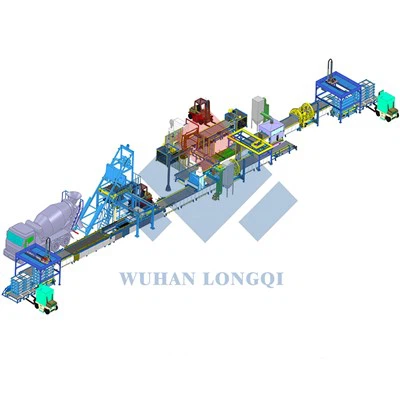


FULL WORKFLOW OF LONGQI PRECAST CONCRETE PRODUCTION LINE
1. Raw Material Preparation and Feeding System
Purpose:
To receive, store, and supply raw materials (cement, sand, aggregates, water, admixtures) to the batching plant.
Equipment Includes:
Aggregate storage bins (multi-compartment)
Belt conveyors or bucket elevators
Cement silos (usually 50–150 tons)
Screw conveyors for cement feeding
Water and additive dosing systems
2. Concrete Batching and Mixing Plant
Purpose:
To accurately weigh and mix concrete materials to required mix designs.
Main Components:
| Component | Description |
|---|---|
| Weighing hoppers | For cement, water, sand, gravel, additives |
| Mixers | Planetary (high precision), Twin-shaft (high volume) |
| Control system | PLC/SCADA with touch screen, mix recipes |
| Output range | 500–3000 L per batch, depending on plant size |
Optional:
Moisture sensors in aggregates
Auto-cleaning systems
RFID or barcode for batch tracking
3. Concrete Transport System
Purpose:
To deliver freshly mixed concrete from the mixing plant to moulds/casting beds.
Options:
Concrete transport carts (rail-mounted or rubber-wheeled)
Overhead bucket delivery systems
Concrete pumps with flexible hoses
4. Moulding & Casting Equipment
Purpose:
To form concrete into the required product shapes using specialized moulds.
Typical Mould Types:
| Product Type | Mould System Used |
|---|---|
| Wall panels | Tilting tables, battery moulds |
| Pipes & manholes | Vibration casting or spin-casting machines |
| Hollow-core slabs | Slipformer or extrusion machine |
| Curbs, pavers | Block/brick machine + mould sets |
| Columns, beams | Longline moulds or tables |
Options:
Modular steel moulds with adjustable dimensions
Self-compacting moulds
Pre-stressing beds for prestressed components
5. Vibration and Compaction
Purpose:
Removes air bubbles and ensures high-density concrete with superior strength.
Methods:
External vibrators (fixed to moulds)
Vibrating tables
Hydraulic or pneumatic vibrators
Internal poker vibrators (for columns/beams)
6. Surface Finishing
Purpose:
Improves aesthetic appearance and surface smoothness.
Options:
Mechanical trowel or screed machines
Surface texture rollers
Color hardeners or surface stamps (for decorative concrete)
7. Curing System
Purpose:
To accelerate hydration and strength gain in controlled conditions.
Types:
Steam curing chambers (80–90% RH, 50–70°C)
Insulated rooms with humidifiers
Electric curing panels for tilting tables
Open-air curing with covers (if budget is limited)
8. Demoulding and Lifting
Purpose:
To safely remove hardened precast units from the moulds.
Equipment:
Hydraulic tilters for wall panels
Lifting beams, clamps, or vacuum lifters
Overhead gantry cranes or forklift lifting frames
9. Storage and Stocking
Purpose:
To organize and protect precast elements before shipment.
Setup:
Open yard with stacking racks
Covered warehouse for sensitive elements
Palletizing system (for smaller parts like pavers/curbs)
10. Optional Systems & Add-Ons
Reinforcement station: Cutting, bending, mesh welding
Pre-tensioning systems: For prestressed slabs/beams
ERP Integration: Inventory, logistics, and production tracking
Robotic arms: For automatic demoulding or reinforcement placement
Automation Levels of LONGQIPRECAST CONCRETE PRODUCTION LINE
Manual: Lower cost, more labor
Semi-Automatic: Balance of labor and productivity
Fully Automatic: Higher efficiency, suitable for large-scale production
Types of Precast Products LONGQI PRODUCTION LINE Typically Produced
| Product Type | Machines Used |
|---|---|
| Wall panels | Tilting tables, battery moulds |
| Hollow-core slabs | Slipformer / extrusion line |
| Curbstones, blocks, pavers | Fixed moulds, block making machine |
| Beams, columns, lintels | Long line casting beds + vibration system |
| Pipes, manholes | Vertical vibration pipe machines |
Detailed
Slope Protection Precast Concrete Components
| Component | Description |
|---|---|
| Solid revetment hexapods | Heavy-duty erosion control blocks for strong hydraulic environments |
| Hollow revetment hexapods | Lightweight slope protection with material efficiency |
| Ecological revetment hexapods | Designed to integrate vegetation with structural stability |
| Hollow hexagon | Open-grid units that reduce water velocity and allow drainage |
| Pheasant slope double hexagon | Reinforced interlocking units for sloped terrains |
| Slope protection block | General-purpose erosion control blocks |
| Interlocking revetment block | Modular blocks with locking geometry to enhance stability |
| A-type slope protection block | Specially shaped for water channels and embankments |
| River chain slope protection block | Articulated block systems for dynamic slope protection |
| Ecological slope skeletons (arched, herringbone, flat) | Grid-like structures for greening and erosion control |
Road & Traffic Infrastructure Precast Concrete Products
| Component | Function |
|---|---|
| Crash-resistant Jersey barriers | Protects vehicles and separates traffic lanes |
| Concrete road slabs | Modular pavement panels for roads and industrial areas |
| Curbstones / Roadside stones | Define road edges, sidewalks, and drainage channels |
| Drainage channels / Drain trough gutters | Collect and direct surface water from roads |
| Gutter plates | Cover drainage points at the curb or road edge |
| Storm drain covers | Allow water to pass while preventing debris entry |
| Bridge culvert approach railings | Safety railings near bridge ends |
| Bridge shutter | Precast barrier or panel used in bridge construction |
| I-shaped bridge deck protective railings | Edge protection for bridges and elevated roadways |
| Joist handrails | Pedestrian or vehicle barrier rails |
| Expansion joint columns / handrails | Absorb movement in long road or bridge sections |
Railway Infrastructure Precast Concrete Products
| Component | Function |
|---|---|
| Railway sleepers (ties) | Support and maintain the spacing of rails; transfer loads to the ballast/subgrade |
| Railway deck guardrails | Protective barriers on bridges to prevent derailments |
| Railway cable trench covers | Cover and protect cables running along tracks |
| Railway covers | Protective elements for drains, utility lines, or structural voids near tracks |
| Bridge culvert approach railings | Guardrails for transitions between tracks and bridges |
| Track foundation pads / subgrade slabs | Distribute loads and support high-speed rail or freight lines |
| Ballast retaining walls or blocks | Prevent displacement of ballast along curves or elevated sections |
Drainage & Utility Infrastructure Precast Concrete Products
| Component | Function |
|---|---|
| Drainage channels | Collect and direct surface runoff from roads and urban areas |
| Drain trough gutters | Shallow surface channels for guiding water |
| Gutter plates | Covers for inlets or road-edge drains |
| Storm drain covers | Cover drainage inlets, prevent debris entry, and allow water flow |
| Trench covers | Provide surface protection for utility trenches |
| Ditch boards / Ditch edge plates / Ditch floors | Structural lining for open ditches and channels |
| Cable trench covers | Protect electrical or telecom cables laid underground |
| Concrete cable trays | Support and organize power/data cables above or below ground |
| Slit cable troughs / U-shaped cable troughs / Three-slot cable trays | Specialized cable routing channels for infrastructure use |
| T-beam U-shaped cable troughs / U-groove connectors | Load-bearing cable ducts with modular connections |
| Subgrade cable troughs | Large cable management systems for highways or rail systems |
Building Structure & Foundations Precast Concrete Products
| Component | Function |
|---|---|
| Concrete columns (upright columns, I-shaped columns) | Vertical load-bearing supports in buildings and bridges |
| Precast concrete slabs | Floor or roof systems; may be solid or hollow-core |
| Foundation piles | Deep foundation elements to transfer loads to stable ground |
| Column foundation frames | Connect columns to substructures, providing structural support |
| Column junctions | Nodes or connection points between vertical and horizontal elements |
| Concrete upper thresholds | Structural elements above doors/windows in precast buildings |
| Concrete pads | Foundations for equipment, machinery, or structural supports |
| Boundary marker piles | Used in site layout, land division, or survey marking |
Precast Concrete Manufacturing Process (Step-by-Step)
1. Raw Material Preparation
Materials Involved:
Cement
Aggregates (sand, gravel, crushed stone)
Water
Admixtures (plasticizers, retarders, accelerators)
Optional: Fiber reinforcement, pigments, steel bars/mesh
Key Actions:
Materials are stored in silos, hoppers, or tanks.
Dust control and moisture sensors may be used for consistency.
2. Batching and Mixing
Purpose:
Precisely weigh and blend raw materials to create fresh concrete.
Process:
Weighing: Cement, sand, gravel, water, and admixtures are measured by weight.
Mixing: Materials are mixed in a planetary or twin-shaft mixer for 60–120 seconds.
Quality Check: Slump, workability, and temperature may be tested.
Output:
Ready-mix concrete with consistent properties.
3. Transporting the Concrete
Process:
Concrete is transferred to casting stations by:
Transport buckets (crane or rail)
Belt conveyors or pumps
Automated shuttles (in automated systems)
4. Mould Preparation
Purpose:
Prepare moulds to define product shape and ensure easy demoulding.
Steps:
Clean the moulds to remove debris.
Apply release agent (oil or water-based) to prevent sticking.
Install reinforcement (if required): rebar cages or mesh placed into mould.
Embed items: lifting hooks, conduits, or anchors.
5. Concrete Casting / Pouring
Process:
Concrete is poured manually or with machines into the prepared moulds.
Special care is taken to:
Avoid air pockets
Maintain a uniform fill
Achieve the correct thickness and volume
6. Vibration and Compaction
Purpose:
To remove trapped air and ensure dense, strong concrete.
Methods:
External vibrators mounted on the mould
Vibrating tables for flat products
Internal poker vibrators for columns/beams
7. Surface Finishing
Process:
Screeding: Level the surface using straight edges or machines.
Troweling: Smooth the surface manually or with power trowels.
Texture/Stamping: For pavers or decorative panels.
Coloring: Apply pigments or color hardeners.
8. Curing
Purpose:
Allow the concrete to hydrate properly and gain strength.
Methods:
Steam curing: Speeds up setting (6–12 hours at 60–70°C).
Ambient curing: Under plastic covers or insulated walls.
Curing chambers: Temperature and humidity controlled.
Typical curing time: 8–24 hours depending on the product and curing method.
9. Demoulding
Process:
Remove bolts or clamps from moulds.
Use hydraulic tilters or cranes for larger elements.
Clean and inspect the product for defects.
Send product for final curing or directly to storage.
Moulds are then cleaned, repaired (if needed), and prepped for the next cycle.
10. Post-processing & Storage
Process:
Apply additional coatings or sealants.
Load and transport to storage racks or yards.
Label products for tracking and delivery.
FAQs
1. What is the daily output capacity?
Depends on product size, number of moulds, and level of automation. Example:
Hollow-core slab: 300–800 m²/day
Curbstones: 3,000–6,000 pcs/day
Wall panels: 40–120 panels/day
2. What are the advantages of precast concrete production?
Consistent product quality
Faster construction timelines
Less waste and labor
Reusable moulds = cost savings
Factory-controlled environment = better durability
3. How do I choose between manual, semi-auto, and full-auto lines?
| Level | Staff Needed | Investment | Suitable For |
|---|---|---|---|
| Manual | High | Low | Small/medium producers |
| Semi-auto | Medium | Medium | Growing businesses |
| Fully-auto | Low | High | Large-scale, high-speed plants |
4. How long is the mould life?
Steel moulds: 5–10 years depending on maintenance
Rubber/PU moulds: 1000–2000 cycles for pavers
Regular cleaning and release agent use extends life
5. How much space do I need to set up a plant?
Depends on product and automation. As a guide:
Mini plant (manual): 500–1,000 m²
Medium line (semi-auto): 2,000–5,000 m²
Full line (auto): 5,000–20,000 m² or more
7. Can the line be customized for different products?
Yes. Modern lines can use:
Modular moulds for adjustable shapes/sizes
Quick-change mould systems
Multi-station tables for mixed production (e.g., wall + floor)
8. What are the main maintenance tasks?
| Frequency | Tasks |
|---|---|
| Daily | Clean moulds, check vibration equipment |
| Weekly | Grease moving parts, inspect mixer & sensors |
| Monthly | Inspect reinforcement tools, check curing units |
| Annually | Service control systems and crane equipment |
9. Can the production line be relocated?
Yes. Most systems (mixer, moulds, vibration tables, tilting tables) are modular and portable. Ideal for companies serving rotating projects or multiple locations.
10. Can I use recycled materials in precast concrete?
Yes, with proper mix design:
Recycled aggregates (within limits)
Fly ash, slag, silica fume
Need proper testing to meet strength/durability targets
11. What is the payback period for a precast plant?
Depends on:
Product type
Production volume
Local labor/material costs
Typical ROI: 2 to 4 years