


Automatic Precast Concrete Production Line
Longqi Automatic Precast Concrete Production Line is a fully integrated and automated factory system designed to produce large quantities of precast concrete elements with minimal manual labor and maximum consistency, speed, and efficiency.
Concrete Precast Machinery for Jersey Barriers And Guard Rail,Types of Precast Concrete Production Line For Sale
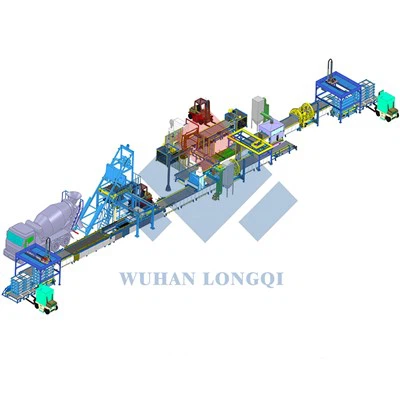


What is an Automatic Precast Concrete Production Line?
It is a comprehensive set of machines and systems that:
Mix and batch concrete ingredients
Pour concrete into reusable molds
Compact, vibrate, and cure the concrete
Automatically move molds and products through each stage
Demold and stack finished precast components
It typically includes automation via PLC/SCADA systems, robotic handling, and real-time monitoring for high-volume production.
Main Components of an Automatic Production Line
| Module | Description |
|---|---|
| 1. Concrete Batching & Mixing Plant | Fully automated batching of raw materials with accurate dosing and real-time monitoring |
| 2. Automatic Mold Handling System | Robotic or hydraulic systems to open, close, tilt, and transport molds |
| 3. Concrete Distribution System | Overhead concrete spreaders or belt conveyors that pour concrete into molds |
| 4. Vibration & Compaction System | Table vibrators or mold-integrated systems for air removal and density control |
| 5. Automated Surface Finishing Unit | Smoothens or textures concrete surfaces (trowel machines, brushes, etc.) |
| 6. Steam or Accelerated Curing Chamber | Controlled environment to harden products faster using heat and humidity |
| 7. Demolding & Ejection Unit | Automatically separates hardened product from molds (hydraulic ejectors or robots) |
| 8. Product Transport & Stacking System | Automated carts, AGVs, or conveyors to move and stack finished products |
| 9. Central PLC Control System | Synchronizes all steps for smooth workflow and data logging |
Benefits of Automation
| Benefit | Description |
|---|---|
| High Efficiency | Continuous production with minimal downtime |
| Consistent Quality | Reduced human error; precision dosing and finishing |
| Lower Labor Cost | Replaces manual pouring, lifting, and curing tasks |
| Scalable Output | Suitable for large infrastructure and housing projects |
| Cleaner Production | Better material utilization and less waste |
| Smart Monitoring | Real-time data on production speed, errors, quality |
Types of Precast Products Typically Produced
Precast wall panels (solid, sandwich, hollow)
Hollow-core floor slabs
Beams, columns, lintels
Stairs and balcony units
Curbstones and pavers
Box culverts, manholes, pipes (with proper setup)
Facade and decorative panels
Manufacturing Process Flow (Example: Paving Block Line)
1. Raw Material Preparation
Materials: Cement, sand, gravel (0–8 mm), fly ash, pigment, water, additives
Storage: Silo or hopper-fed system
Weighing: Automated batching system ensures accurate proportions
2. Concrete Mixing
Mixer: Planetary or twin-shaft mixer with moisture sensors
Cycle Time: 1.5–3 minutes per batch
Output: Semi-dry concrete with consistency suitable for vibro-compaction
3. Material Transport to Block Machine
Conveyed via:
Skip hoist
Belt conveyor
Aggregate feeding hopper
4. Paving Block Forming (Main Block Machine)
Core Machine: Vibropress with hydraulic pressing + vibration compaction
Mold Options: Interlocking blocks, zigzag, I-shaped, hexagonal, custom logos
Surface Finish:
Single-layer: Grey concrete
Double-layer: Color layer via face mix feeder (for decorative pavers)
Cycle Time: 12–18 seconds per pallet (can produce up to 10,000–15,000 blocks/day)
5. Automatic Pallet Conveyor & Cubing
Blocks placed on steel or PVC pallets
Moved via:
Finger car
Hydraulic lift elevator + lowerator
Cuber System:
Robotized arms or hydraulic grab stackers
Stack onto wooden pallets for storage
6. Curing
Steam/Chamber Curing (optional for speed)
Natural curing in stacks (24–48 hrs)
Humidity: 85–95%, Temperature: 40–60°C (if steam used)
7. Packaging and Dispatch
Automatic pallet strapping & wrapping system
Optional: Palletizer for shrink wrapping or stretch hood
FAQs
What is the difference between manual and automatic lines?
Manual lines rely on human operation for most steps.
Automatic lines use robots/conveyors/PLC for material handling, pouring, vibration, and demolding.
What power and space do I need?
Power: 100–500 kW
Space: 1,000 – 5,000+ m² depending on layout and products
How many workers are needed?
Only 5–15 operators for a fully automatic line vs. 30–50 for manual production.
Can one line make multiple products?
Yes, using interchangeable molds and flexible pouring systems.
Can it be integrated with BIM?
Yes. Most modern PLC systems support BIM-to-manufacturing integrations for panel detailing, embedded elements, and logistics tracking.
What about maintenance?
Daily: Lubrication checks, sensor cleaning
Weekly: Vibration system inspection, hose check
Monthly: Mixer liner inspection, PLC software backup
How long is setup?
Manufacturing lead time: 3–5 months
Installation & training: 2–4 weeks
Civil foundation: 4–8 weeks (parallel timeline)
Environmental Considerations?
Water recycling system for mixer washout
Enclosed dust collection systems
Optional solar-powered curing chambers
Can the line produce multiple block types?
Yes. You can switch molds (within 20–40 min) to produce different designs.
What’s the ROI time?
Typically 12–24 months depending on plant size, local demand, and sales price.
How many molds do I need?
Start with 3–5 mold sets based on your market (e.g., 60x200x100mm, zigzag, kerb). More molds = more product options.